When arteriosclerosis is left unchecked, heart failure is inevitable. The transportation systems constitute the arteries and veins of the urban body. The clogging of these arteries undermines the health of urban life and prevents sustainable development.
A good example is the increasing volume of traffic through Ontario’s "golden horseshoe", which is an international artery. The vehicular traffic between Canada and USA and the growing number of visitors to Niagara Falls compound the high number of commuters in the grater Toronto area.

The main issue in “clearing this artery” is the environmental impact of expanding the existing highway, or of developing a parallel railway. Traffic demand on highways could be greatly reduced by incorporating an elevated Light Rapid Transit (LRT) monorail over the median and/or shoulders. This would not require additional land and the environmental impact would be minimal. This would also use the highway infrastructure and the land, it occupies, more efficiently.
By prefabricating the entire structure supporting the LRT, its erection would cause minimal disruption to the highway traffic. A specially developed crane, completed with a drilling machine, could access the median from the shoulder without having to close any lanes. The system of piers and beams could support a conventional electric train, yet it would make sense to provide for a possible future conversion to the higher speed and safer magnetic levitation system. The concept has other advantages as well, such as sheltered roads that do not need ploughing and salting in winter and safer wet driving conditions. In addition, a solar collection sail installed above the railways could generate electricity and provide lighting to the highway below. The raised infrastructure could also support high-tension wires to transport electricity and communication lines.
Firstly, it should be the role of governments to invest in the research and development of this concept. Secondly, it would make sense to invest into manufacturing facilities that would produce all necessary components. A partnership between governments, major contractors, precast manufacturers and steel fabricators could develop these in a cost effective way. The initial high-cost of the plants and equipment would be a onetime long-term investment. Considering all the elements involved, this project could bring a much needed and long-term economic boost. At last, but not the least, Mother Nature would benefit.
The most harmful effect the highway network has caused, even more than noise and air pollution, is the fact that it has produced her fragmentation. The world’s flora and fauna, originally functioning as a cohesive living organism, have been split-up into ever shrinking islands, with growing physical restrictions on wildlife. In time, transferring the traffic load, from the ground to the elevated trains, and maintaining only two-lane low speed roads for local traffic, service and access to train stations and parking lots, would scale down the old highways and correct the damage done to the natural environment. Wildlife will be free to cross and move freely again throughout the land.
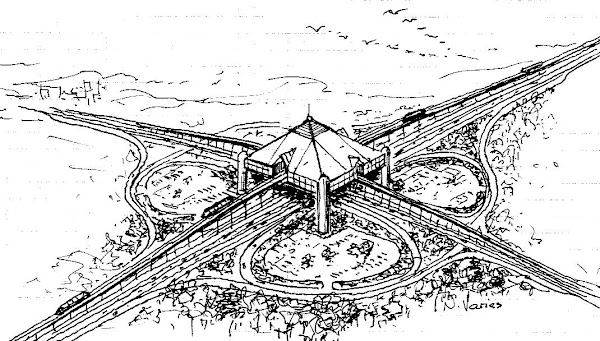
As illustrated, Mobility Interchange Hubs (MIH), built above the highways at present carpooling parking lots and overpasses, would connect all modes of transportation (trains, streetcars, buses, automobiles, motorcycles, bicycles and pedestrians). Each MIH could incorporate a mini-mall with essential services, public amenities and commercial space. This would
open the door to the creation of a local Public-Private Partnership for its development.


